9.29.2006

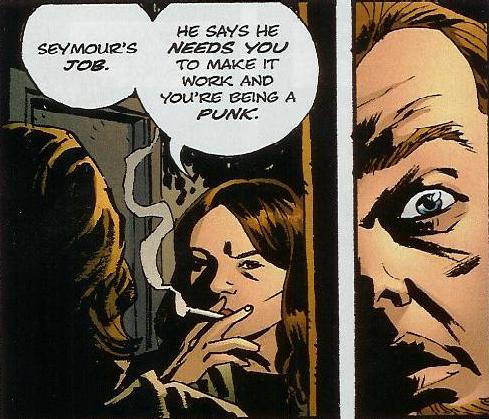
Criminal 1 by Ed Brubaker and Sean Phillips


There are many comics these days that can be categorized as crime comics, but most of them include another genre convention. They involve super-heroes or former super-heroes, they investigate something supernatural or fantastic, or in the most famous case, Sin City, they are set in a world that never seems real, but never decides on how much unreality it should include. There are some traditional crime comics, set in an approximation of the real world, that eschew the fantasy that most mainstream comics, crime-related or not, participate in. This series appears to be one of those.

Many of Brubaker's past series have used the trappings of the crime genre in telling their stories: Sleeper, Daredevil, Catwoman, and Gotham Central to name the most popular. Some of his other series featured characters who were criminals, such as Deadenders and Lowlife. This book looks to live up to its title and avoid all the distractions from other genres. Straight-up criminals committing straight-up crime.

The first issue provides a promising set up for the series. We're introduced to our main character, Leo, and given just enough background to sympathize with this hardened criminal. The real joy here is the prose itself. Hardboiled without being overdone, Leo as narrator avoids the Mickey Spillane schtick that Frank Miller does so well and each supporting character is given a distinct voice in the the few pages that they appear. The foundation for the plot is laid, and my hope is that Brubaker can hold it together until the pay-off. A story like this can sometimes be masterful for the first two acts, then fall apart with a weak ending. I'm hooked from this issue though, and trust that my investment will be rewarded.

The storytelling is fluid, thanks to the comfortable rapport that Phillips and Brubaker have built up over their last collaboration, Sleeper, and they know when to get out of each other's way. In an issue that is 90% talking heads, Phillips manages to create an easy flow to the pages and keeps the reader in tune with the right amount of scenery changes and his unique rendering style. A Phillips character looks like a Phillips character, but he manages to keep them all distinct with his art as well. The issue carries a gorgeous cover, blood red and chunky orange, and the interiors are held together by the heavy blacks that allow Phillips to be good and fast. Phillips is a craftsman to be sure, but his pages hold the love of art and the search for truth.

9.26.2006

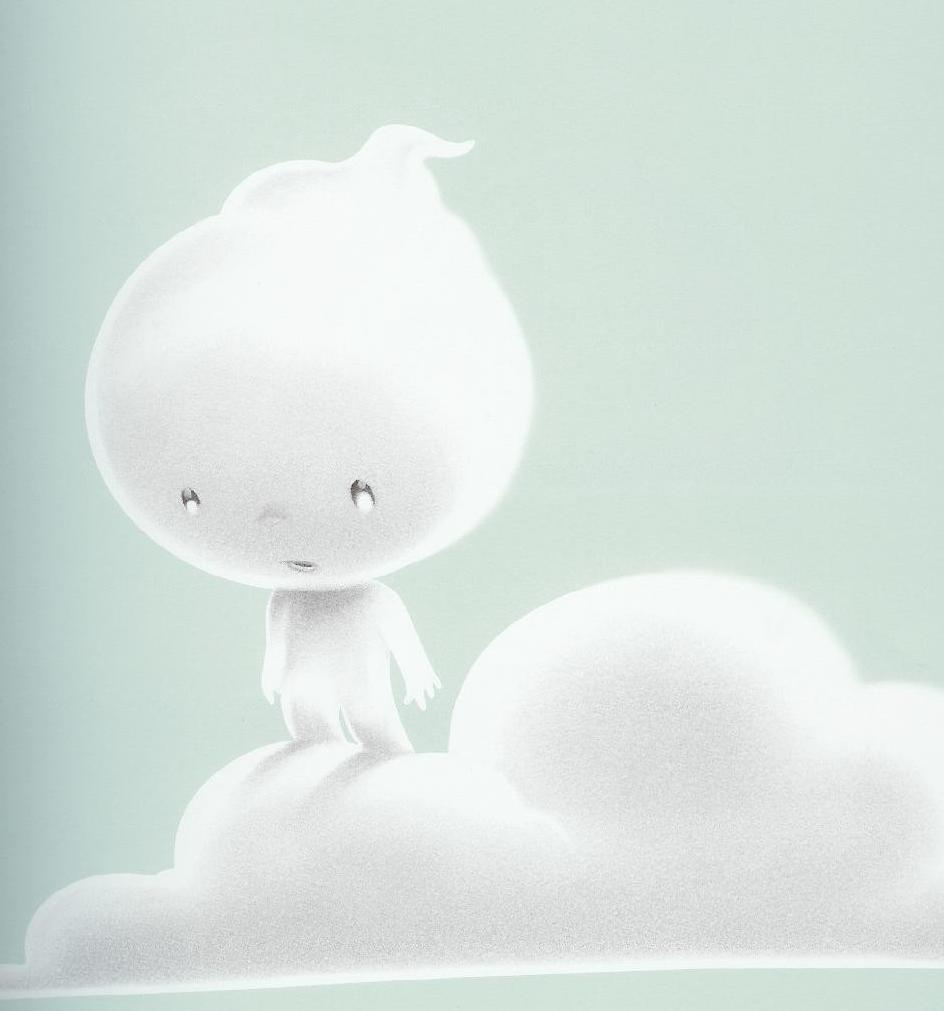
Cloud Boy by Rhode Montijo - An Appreciation


This is a new children's book from an artist that has drawn comics, works as an illustrator, but is probably most famous online for his collaborative effort, Happy Tree Friends. I picked this book up at SDCC, but I admit that I probably wouldn't have if I didn't have a nine month old daughter. My book "collection" before my daughter was born did contain a few books that are conisidered children's books, but they were few and far between. This book, however, I would recommend to anyone who is a fan of illustrated books at all.

The story is as simple as could be, in fact it's perfectly simple, a story pared down to poetry, yet the idea is so expansive that it sets the imagination free, allowing for you to carry it with you long after you put down the book. The text is carved down to deliver the essence without losing the rhythm that a children's book needs, being so commonly read aloud. With a minimum of effort, the script allows you to feel confident that you are reading the words with the conviction of the greatest of Shakespearean actors, no mean feat for a story that consists, textwise, of only 123 words. This expressiveness, the appealing sound the words create in the speaker's mouth, are the first thing that make this book the favorite of my daughter. She need only hear the first line of the book, "High up in the sky lived a lonely little cloud boy," for a smile to cross her face.

It's the idea behind the book that makes it a favorite of mine. As a child, my parents allowed me access to many of the great children's book of the last century, created by those names familiar to us all, Silverstein, Seuss, Rey, Kipling, De Brunhoff, and others. The very best of these books had lessons that adhered to my brain and remain with me today. Seuss's lessons of inclusion, pride, and achievement, Rey's lessons of adventure, Silverstein's lessons of love and generosity, these are the types of books that one can be proud to share with their children. I hope that my daughter finds that her family encourages creativity and individuality, and I can see this book planting those ideas in her someday. Montijo makes the story so easy to latch on to that the beauty is suffused through the repeated readings.

The illustrations are amazing as well, the iconic appearance of the title character makes it easy to identify and empathize with. The light and airy pictures expand the freedom of the idea, creating the feeling that all the pages take place over a giant tableau, each one being a small snapshot frozen in time, but free in space. This freedom creates a peaceful feeling in the reader, who when reading to others is of course the narrator, and that peace spreads out to the listener.

It won't be too much longer before the words become an imprint in my memory, and the story will be able to unfold in the world whenever I want it to, perhaps under the very clouds that inspired the author to tell this wonderful tale, and it will allow me to use the very creativity that the author hopes to inspire.

9.15.2006

Pride of Baghdad by Brian K. Vaughan and Niko Henrichon

The precedent set for anthropomorphic comic books or cartoons is that the animals will, in some way, be illustrated to highlight human emotions and enable a connection with the reader that wouldn't be present from a realistic drawing. Whether it's simplifying the character to a cartoon abstraction as Gary Larson would in The Far Side, or adding human characteristics such as emotive eyebrows as you would find in Disney's lions. It is to the credit of Vaughan and Henrichon that they rely on neither of these.

The art is representational throughout. Henrichon's style is one of the most realistic that you will find in comics. This services the story told as its main characters a small group of lions, the titular Pride. We see the entire story over the shoulders of these lions, and the dialogue is where we get the emoting. Vaughan is capable and adept at deciding how the visual flow of the page should come, in fact he's one of the best out of the list of writer's who exclusively write, it's just that his command of the words allows him to let the art work on it's own rather than as a crutch to support the writing. Of course, great comics aren't made without the art complementing the words, but when trying to compose a story that uses formal play (lions who are in every way animal except for the thoughts they speak to one another in word ballons) it's important to not let the method become the message.

A story set in Iraq in 2003, while Baghdad was being bombed and occupied, is naturally going to be a divisive topic in a country where politics is the ultimate symbol of division. Vaughan mitigates this by keeping his proselytizing to himself. His one overt comment (the last line of the book) is kept covert enough by its careful wording. In this country we're so constantly reminded that artists are liberals and the military is conservative that it is difficult for me to avoid deciding the political stance of a comics author before I read a comic that references politics. And I've read enough Brian K. Vaughan comics to think of him as a liberal. This book, however, does a wonderful job of staying off the soapbox and simply telling a story. He infuses his animal characters with such humanity that I found myself as picturing them as humans rather than the cartoon delineations that we are all familiar with.

The story does feel a bit filled out, as though it could have been told in half as many pages, but Henrichon's art is so strong that it provides a visceral thrill when you take the story out of the occasion. Realistic, but with the immediacy of life drawing studies, he holds control of the page by covering all the bases in what would frequently be a team effort. Normally we would have a separate inker, or at least colorist on a DC comic, but Henrichon handles everything except lettering himself. It allows him to produce some pages with what looks like digital inking, some with what looks like scanned pencils, and others with traditional inks that are colored in the same rendered color as every other page in the book. He has enough control over his computer coloring that he can make pages that are rendered with different techniques flow together seamlessly.

While this book is not quite the masterwork I was hoping for (I believe that Vaughan will one day helm a short work that will match the quality of his outstanding longer works, Y the Last Man and Ex Machina), it is certainly a proud (ugh) addition to my library.

9.13.2006

I Am Going To Be Small by Jeffrey Brown

As I've said before, I like emo comics. I appreciate the earnestness of a guy writing "about cooking pasta alone on a rainy night", if he's writing the truth. The main drawback to emo comics is that they are never funny enough. These books are so busy taking everything so seriously that they forget how silly someone looks when they are in love. To pick on someone whose work I really enjoy, Craig Thompson is an example of a guy who is ripe for laughing at because he too seldom laughs at himself in his comics. Again, I enjoyed Blankets, and I think that Goodbye, Chunky Rice is a very good comic, but I think that Thompson will really hit his stride when he learns to inject his work with a little more humor.

Now Jeffrey Brown is a guy who broke out by doing some very earnest comics, Clumsy and Unlikely. The humor in those books was limited to inside jokes and cutesy moments. While making these twee little books, he was apparently also amusing himself with gag books. The title reviewed here is a mini-comic that he expanded for this "official" release through Top Shelf.

Brown can be very funny. His self-parody comic, Be A Man, exposes the id of the Jeffrey Brown character that is the protagonist of Clumsy, and it works perfectly at extracting laughs. It's much funnier than the parodies of his work that I've found in Krayon's Ego or Comic Book Apocalypse. He shows that he's capable of seeing the self-seriousness of his work, and tears it apart.

The book at hand, unfortunately, misses the mark more often than not. It might be that this book is the comic book equivalent of the deleted scenes portion of most DVDs. You watch these scenes, and most of the time you understand exactly why they were cut from the final film. The gags that this book was expanded to incorporate are on the same level. An occasional chuckle, but much more frequently limp jokes. The art is as strong as the last several books that Brown has released, and there are many panels that aren't very funny that are saved by the appearance of his drawing style for the reader familiar with his oeuvre. To see the same illustrations that portrayed such earnestness portray such silliness can have a positive cumulative effect, and he has an understated style that lends itself to the absurd, and makes palatable the jokes which only Brown or his friends could possibly understand.

There is an entire section at the back of the book that is devoted to an approximation of an indie comic gag strip with recurring characters. The problem is that the characters, all cutesy anthropomorphic of woodland animals are completely interchangeable, with no individual personality amounting to anything. In fact, the two female characters are illustrated with fur-covered breasts, just in case we forget that they are supposed to be the females. Each gag is set up as a generic joke, feeling like they were something that Brown thought was funny while writing his autobio books, but they weren't "true" enough to make it into those books. Each time the male characters, the bear or the bird, are talking, they do nothing to distinguish themselves from one another. The females, the bunny and the cat, are just as indistinct. It might be that Brown is intending for this to be another self-parody, turning himself and his relationships into gags, but if that is the case, Be A Man is the much more successful example.

9.10.2006

David Hahn


One of my favorite things about being a comics fan is that most of the creators that you follow are not out of reach. There are exceptions, of course: the dead, the recluses, the dickheads. For the most part they are available to their fans. I have had the great fortune to meet many of the legends of comic history over the years at comics conventions, and I kick myself for not approaching the few that I should have (Eisner in particular). In any case, one of my favorite reasons to go to the San Diego Comic Con each year is to meet a comics creator that I've never met before. I met several that I'd never heard of before, and a few that I was already a fan of, but had never seen in person.

One that I am a fan of, that I had the opportunity to meet for the first time was David Hahn. I made mention of him in relation to his most recent series, Bite Club, and he strolled up to the booth of the friend I was helping at the show. I noticed his name on his badge (once you start reading badges at a show like that, you'll never stop, you'd be amazed at who you could be talking to) and introduced myself. He was very gracious and humble and gave me directions to his table so that I could check out the work he had for sale at the show.

I finally got a chance to find his table a day or so later, and grabbed a copy of the sketchbook he had for sale (I sampled a page for the image above) as my friend grabbed several pages of art. This story is not meant to be a name-drop, just another example of the accessibility of artists in the medium that I remain such a fan of, and to bring up a specific example of an artist who was friendly, and that he is one of many.

9.09.2006

Local by Brian Wood and Ryan Kelly

Maybe I'm just a sucker for emo comics.

Brian Wood is another guy that I never bothered to read. The early works I saw, like Channel Zero, never struck my fancy. I read Pounded, but it smacked of trying to hard. The blurbs that I read about Demo always sounded interesting, but whenever I grabbed the books themselves I was just kinda, "ehh", but now that I'm a Becky Cloonan convert as well it might be worth another shot. Local, though, looked good enough from the solicitation that I tried it out blind when it came out even though I didn't bother with DMZ or Supermarket.

I've enjoyed this series very much. The art is consistently strong. There are a few hinky panels here and there, but Ryan Kelly strikes a nice balance between his fast and loose brush and his tight layouts. He does a great job varying the shots -- even though it tends to be page after page of talking heads -- without ever giving the sense that he's cribbing from Wally Wood's "22 Panels." I look forward to more work from this artist and think that he might grow into a comics strong-man.

There is a self imposed stylistic decision to set each issue in a different North American city or community, and the series so far is mostly about one character, but each issue is told as a standalone as well. I'm not sure if that should be a selling point for a limited series, but if you're on the fence, any issue is a fine starting point and there's no need to go back to the first issue.

(Does anyone even buy comics anymore unless they know whether or not they're going to like it. And I don't mean first issues, would anyone out there just pick up the 6th issue of an ongoing series just to see if it fits their taste. I've got to imagine that most of you would either read an issue in the comic shop or read enough to know that you're going to buy the trade when it comes out.)

The stories do feel like they are building to the finish, and the supplemental material in this issue (6 is the most recent at the time of writing) says as much. Brian Wood admits that this stand alone story does contain some reference to previous issues, but I think that they are minor, and only add to the depth that Wood is trying to create. I will say this as warning: If you are turned off by the idea of a comic about a 20-something who is trying to find her way, stay away from this book.

Maybe I'm just a sucker for emo comics.

9.06.2006

Krayons Ego edited by Jesse Reklaw and Karen Sneider


This is an anthology of parodies of the well-respected indie comics anthology, Kramer's Ergot. Now, this has been done before. Kurt Wolfgang did it in Low Jinx #3, Ed Brubaker and Sam Henderson and others did it in Deceased Corpse, and Johnny Ryan performed his own version of it in the recently expanded Comic Book Holocaust. This comic and Low Jinx both went for the method of cartoonists (there is a list of contributors, but they are uncredited as far as who drew what) picking specific creators and doing stories in the style of the original, but parodying the content. As an example, see the above panel from the parody of Tom Gauld's one page musings on famous authors. In this series of one-pagers, comic creators like Sammy Harkham are treated to ridicule in an artistic style that very accurately apes Gauld's. A few other Ergot contributors are targeted, but then the conspirators move onto bigger and more famous subjects, seeking and destroying James Kochalka, Craig Thompson, publishers Top Shelf and AdHouse, and even parodying a parody by carving up Johnny Ryan.

Now I used a lot of non-commital synonyms for parody in that last paragraph, but the fact is, I love this shit. I very much enjoy nearly every creator that is satirized, and when the stories are brutally mean but still funny, I enjoy it nearly as much as reading the originals. I especially appreciate the fact that they take on creators that are so critically respected. Most people are willing to take potshots at Craig Thompson, but I thought Paper Rad and Mat Brinkman were unassailable. All the better, they are just as rough when it comes to these guys. It just goes to show that you can't successfully parody without a familiarity or a love for the source material.

The art in this book is surprisingly strong. As I mentioned above, individual stories are uncredited, but the artists listed do a fantastic job of aping their respective comics. Art is credited to Tom Neely, M. Campos, Clutch (link?), Josh Frankel, Sarah Oleksyk, Jesse Reklaw and Karen Sneider. I don't know who's responsible, but the artists in charge of the parodies of Tom Gauld, Craig Thompson and Jeffrey Brown perform an excellent job of facsimile. They get the art just right, and they tear apart the tropes that those artists (over)use. The James Kochalka, Paper Rad and John Porcellino swipes come close, but there are giveaways that cause you to see the hand of the parodist at work.

The writing is strong, and only occasionally do the stories fall into the very trap that they accuse Johnny Ryan of, namely falling back on sex, drug and shit jokes when they don't have a ninsightful target in mind. The rest of the time, though, the hits are accurate enough to make me wince for the recipient.

9.04.2006

Your New Religion Books one and II by Joe Sayers


When I first saw these mini comics I thought they were by Nicholas Gurewitch of Perry Bible Fellowship fame. The PBF is maybe my favorite online comic strip, given that I have no interest in video games and I can't relate to Achewood. So anyway, the surface similarities led me to connect this mini-comic with The PBF, and when I looked closer I realized that I had made a connection based on the title and a cursuory glance at the art, but upon inspection realized that this was a separate creation all together.

The books themselves are small in their sense of scale, both of them measuring 3.5 inches by 4.25 inches, and the guts are photocopied in black and white, but they also have some typical mini-comic upgrades, reflective foil covers and a stamp in issue one. Each book consists of 36 pages of single panel cartoons, all based on the title conceit being that they are tenets and features of "your new religion".

The books are funny. Drawn with simple moon-faced characters you see above, the gags range from goofy non-sequiturs ("Lick a cat for forgiveness") to inversions of traditional religious dogma ("Mandatory suicide for impure thoughts"). The art is confident and carries the appropriate amount of information, and nuanced with tones that look to be created by colored pencil. The artist, Joe Sayers, was new to me, but after enjoying this book I spent some time on his website, including time with his webcomic, thingpart. You can also pick up the Religion comics there.

9.02.2006

Schematic Comics by Dan Zettwoch

I first read about the USS Catastrophe collective (if that's the right name for it) a couple years ago. I had heard the name, and the names of the main crew of this comic-makin' ship, Kevin Huizenga, Ted May, and Dan Zettwoch, but I'd never hunted for the works of these guys until the 2004 election prompted them to hold a fund raiser. I sent my $25 bucks and received a drawing by Mr Huizenga. This introduction started my fanaticism for Huizenga and my desire to learn about May and Zettwoch.

I'm not sure when this mini came out. It's dated 2005, but I picked it up at San Diego Comic Con this past July. It's a compilation of short stories by Zettwoch, and features such highbrow mini-comic additions as screenprinted covers and pages, die-cutting, and a fold out centerspread. The collections title testifies to the love that Zettwoch has for plans and schema and things made by hand. Stories regularly feature the appearance of maps, directions, outlines, diagrams, rules and standards. The stories are generally told from the perspective of the blue collar artist, a craftsman in the best sense.

The artwork and storytelling skills of Zettwoch appear to be in flux in this anthology, and I presume to place stories on a timeline based on the confidence of line and fluidity of story flow. I assume that "Northwestern Parkway" and "The Secret Society of Six Mile Lane" come first in the chronology of creation, and that "Speak For Yourself Fold-In" or "Making My Own Mini-Comic" would fall towards this end of the timeline. The brushline gets smoother and the inconsistent crosshatching of early stories transforms into confident blacks and appropriate tones. I will be sure to add more Zettwoch titles to my collection. In fact, maybe I'll go order some right now from USS Catastrophe dot com.